
Throughout history, people from every corner of the globe have ventured to America—a special land where hard work, optimism, and value creation are rewarded like nowhere else. This is the place where Albert Einstein fled persecution to revolutionize physics, where Sergey Brin arrived as a refugee and co-founded Google, where Elon Musk came with $2,000 and built companies worth hundreds of billions, where Satya Nadella and Sundar Pichai rose from international students to CEOs of trillion-dollar companies.
America's magic isn't just in its universities or its companies—it's in the culture of possibility.
The Uncomfortable Truth: This Path Isn't for Everyone
Before we dive into why America remains unparalleled for STEM talent, we need to address the elephant in the room.
If you scroll through Reddit or Instagram during Fall intake season, you'll see videos like this one from Hyderabad Airport—thousands of students, many with their entire families, heading to the USA for graduate school. The comments tell a familiar story: students taking massive loans, following friends, chasing a dream they don't fully understand.
Massive crowds at Hyderabad Airport during Fall 2023 intake - thousands heading to the USA for graduate school
Source: Reddit - Huge crowd at Hyderabad Airport
This is herd mentality, and it's dangerous.
Here's what the Instagram influencers and YouTube "consultants" won't tell you: student life in the USA for internationals—especially on borrowed money—is miserable if you don't have the skills to back it up.
The upside of coming to America only exists and begins if you:
- Score competitive internships during your program
- Land a full-time job offer after graduation
- Actually have the technical and professional skills to compete with the best
If you're coming to the USA because "everyone else is doing it," or because you think a US degree is a participation trophy that guarantees success, you're going to be miserable. The loans will crush you. The competition will overwhelm you. The job market will reject you.
The American Dream rewards the worthy, not the hopeful.
But if you ARE skilled, if you ARE ready to compete with the smartest people on the planet, if you ARE willing to work harder than you've ever worked before—then there is no land on Earth that will open more doors for you than America.
Let me prove it to you with data.
Why Gradmits Believes USA is Still the King: Two Data-Backed Arguments
Despite all the fear, uncertainty, and doom-scrolling on Twitter about H1B restrictions and visa policies, the empirical evidence tells a completely different story. Let's look at the numbers.
Argument 1: The Opportunities Are Growing, Not Shrinking
Big Tech Hiring at Record Highs
Everyone on social media is screaming about tech layoffs and visa restrictions. But what does the actual data show?
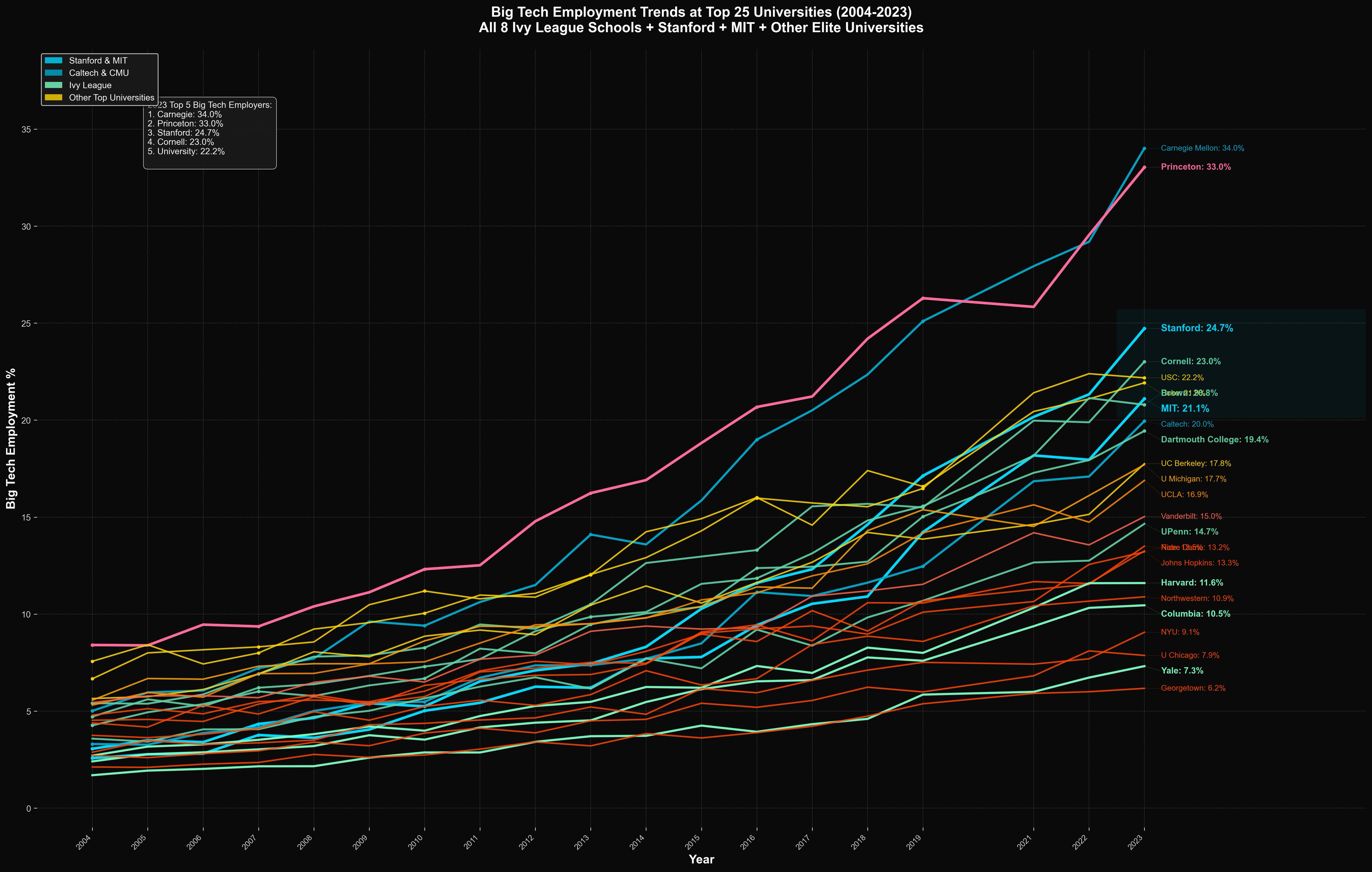
Source: U.S. Immigration and Customs Enforcement - SEVP Data
This chart tracks graduates from the top 25 universities (all 8 Ivy League schools + Stanford, MIT, and other elite institutions) who went into Big Tech employment from 2004 to 2023.
The results are stunning:
- Princeton: 8% (2004) → 33.0% (2023) — that's a 4.1X increase
- Stanford: 8% (2004) → 34.7% (2023) — 4.3X increase
- MIT: 8% (2004) → 21.7% (2023) — 2.7X increase
- Cornell: 5% (2004) → 23.9% (2023) — 4.8X increase
- UC Berkeley: 10% (2004) → 17.6% (2023)
- Columbia: 8% (2004) → 19.5% (2023)
Even with all the layoffs in 2022-2023, 2023 shows near-record highs for Big Tech hiring from top schools. The trend line over 20 years is unambiguously upward.
And who do you think makes up a significant portion of the STEM graduates at these schools? International students.
The OPT Pipeline is Massive and Resilient
Optional Practical Training (OPT) is the bridge between your student visa and long-term work authorization. It's the single most important pathway for international students to enter the US workforce.
Let's look at how this program has evolved:
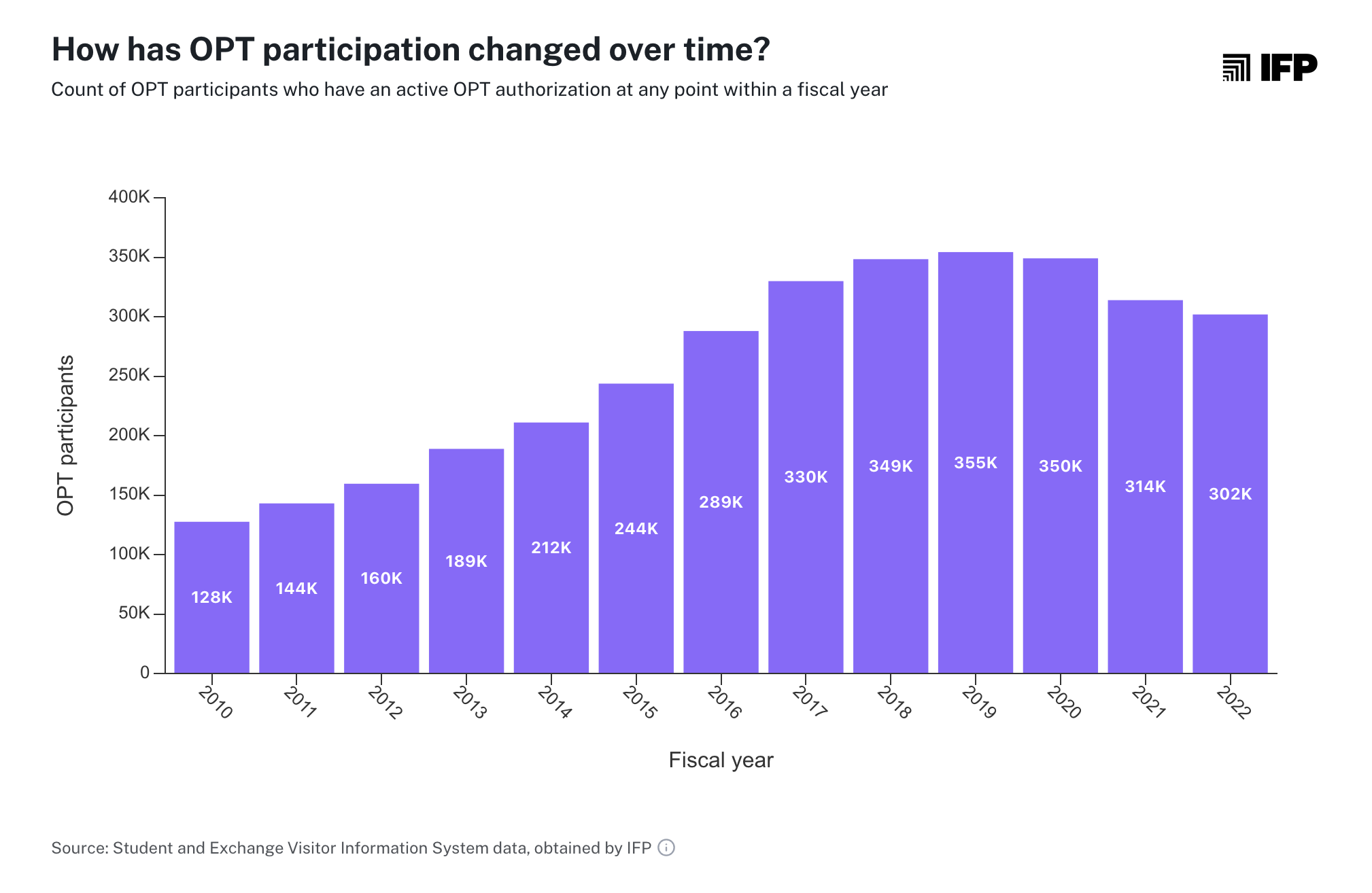
Source: Institute for Progress - OPT Observatory
The data from the Institute for Progress shows:
- 2010: 128K active OPT participants
- 2019: 355K active OPT participants — 2.77X growth
- 2022: 302K active OPT participants — still 2.36X higher than 2010
Yes, COVID caused a dip. Yes, there was a decline from the 2019 peak. But let's zoom out: the OPT program is still more than twice the size it was a decade ago.
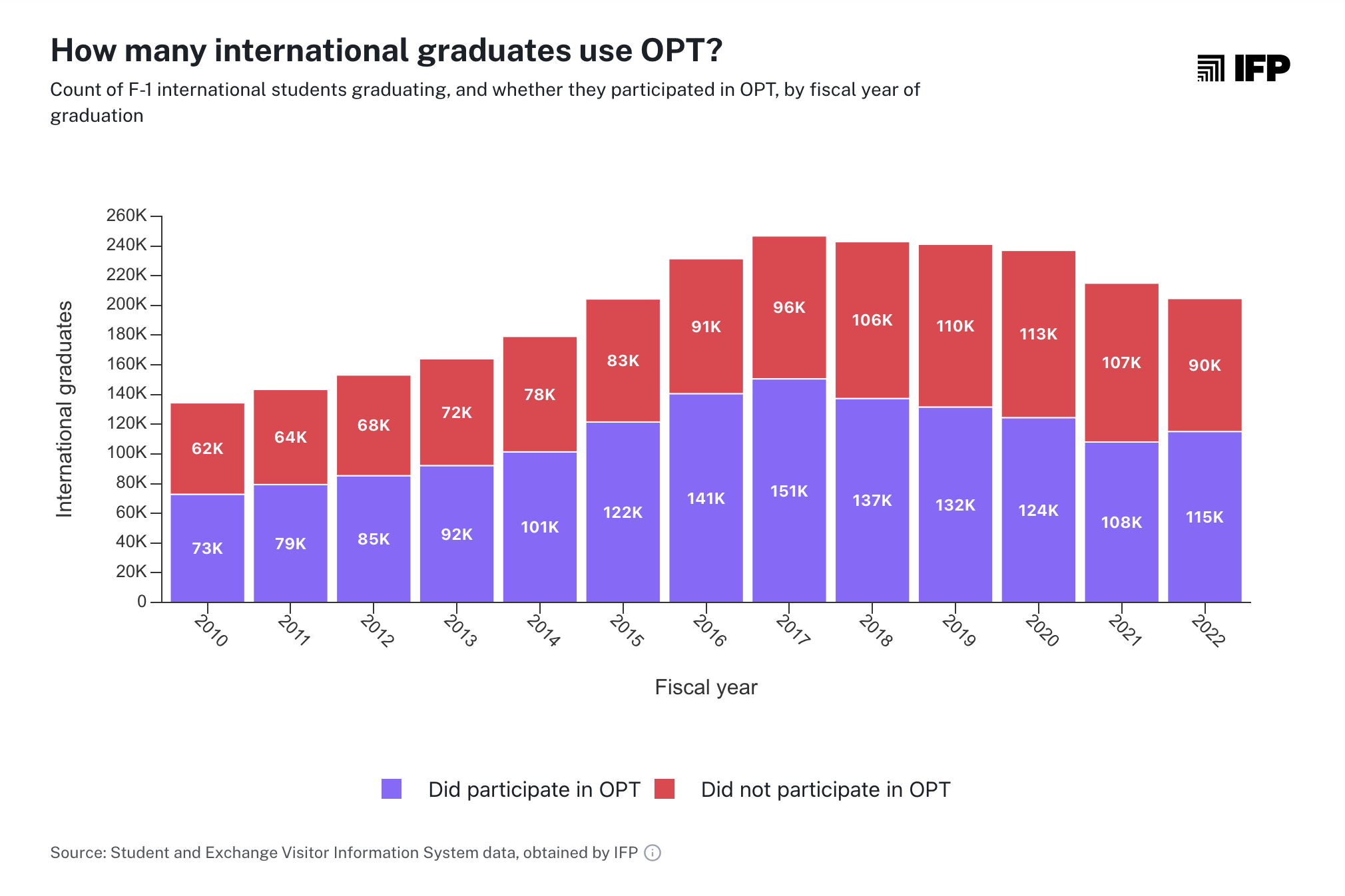
Source: Institute for Progress - OPT Observatory
In 2022:
- 205K international students graduated from US universities
- 115K of them (56%) participated in OPT
- Among STEM PhD graduates, 76% used OPT
- Among STEM master's graduates, 64% used OPT
This is not a dying system. This is a mature, proven, and massive pipeline for international talent into the US workforce. Over 300,000 people are working on OPT right now—more than any other skilled immigration pathway.
STEM in America Depends on International Students
Here's the stat that should make you realize how essential international students are to the US innovation economy:
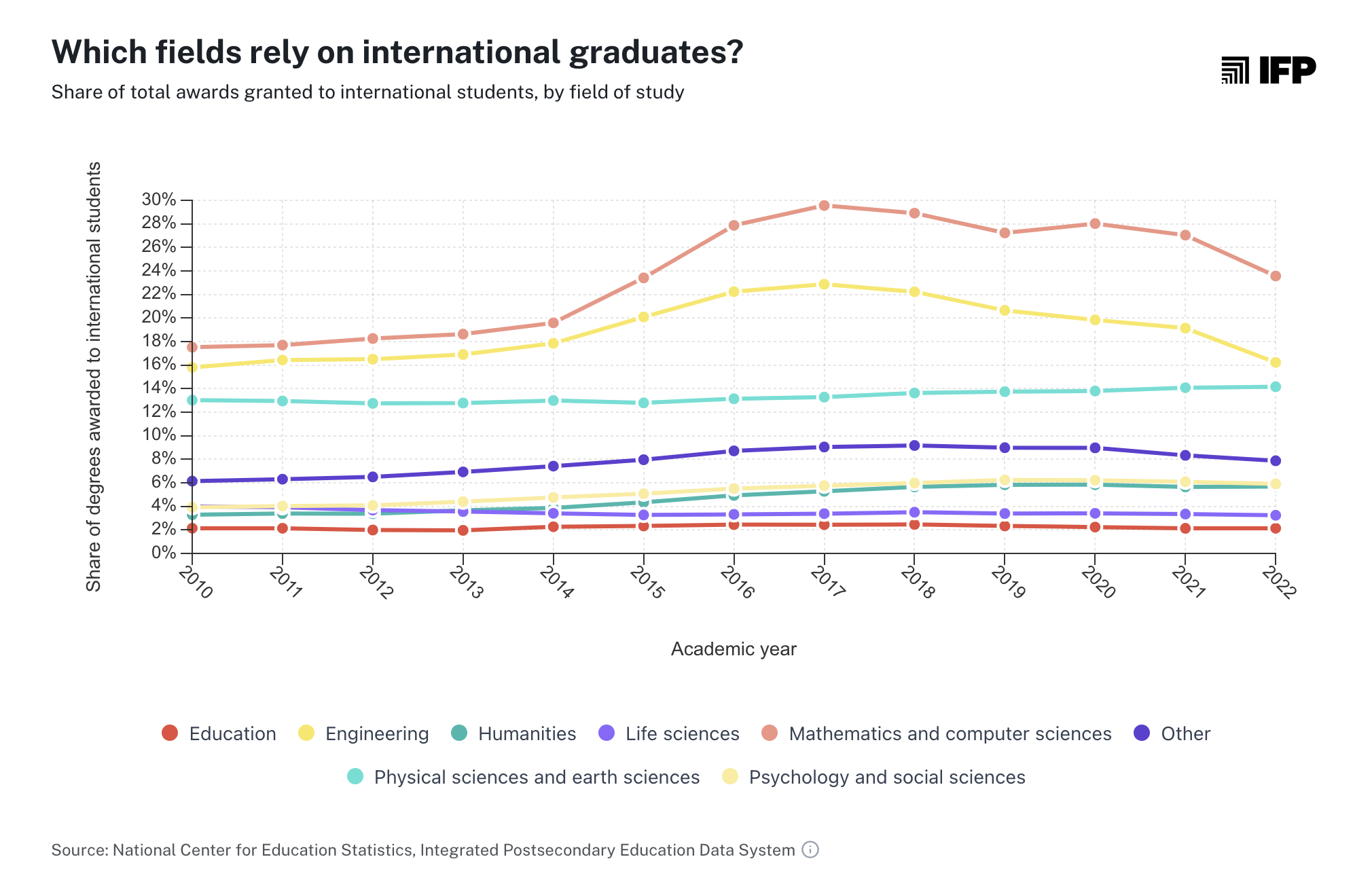
Source: Institute for Progress - OPT Observatory
In 2022:
- 24% of all Math and Computer Science degrees went to international students (peaked at 30% in 2017)
- 16% of all Engineering degrees went to international students
- 14% of all Physical Sciences degrees went to international students
- At the PhD level, the numbers are even more dramatic:
- 58% of Math/CS PhDs went to non-US residents
- 56% of Engineering PhDs went to non-US residents
- 41% of Physical Sciences PhDs went to non-US residents
Read that again. Nearly 6 in 10 PhDs in the most critical fields for AI, semiconductors, and advanced technology go to international students.
America's innovation economy would collapse without international talent. And the US government knows this. That's why, despite all the political noise, the OPT program has remained stable and even expanded for STEM students (with the 24-month STEM extension).
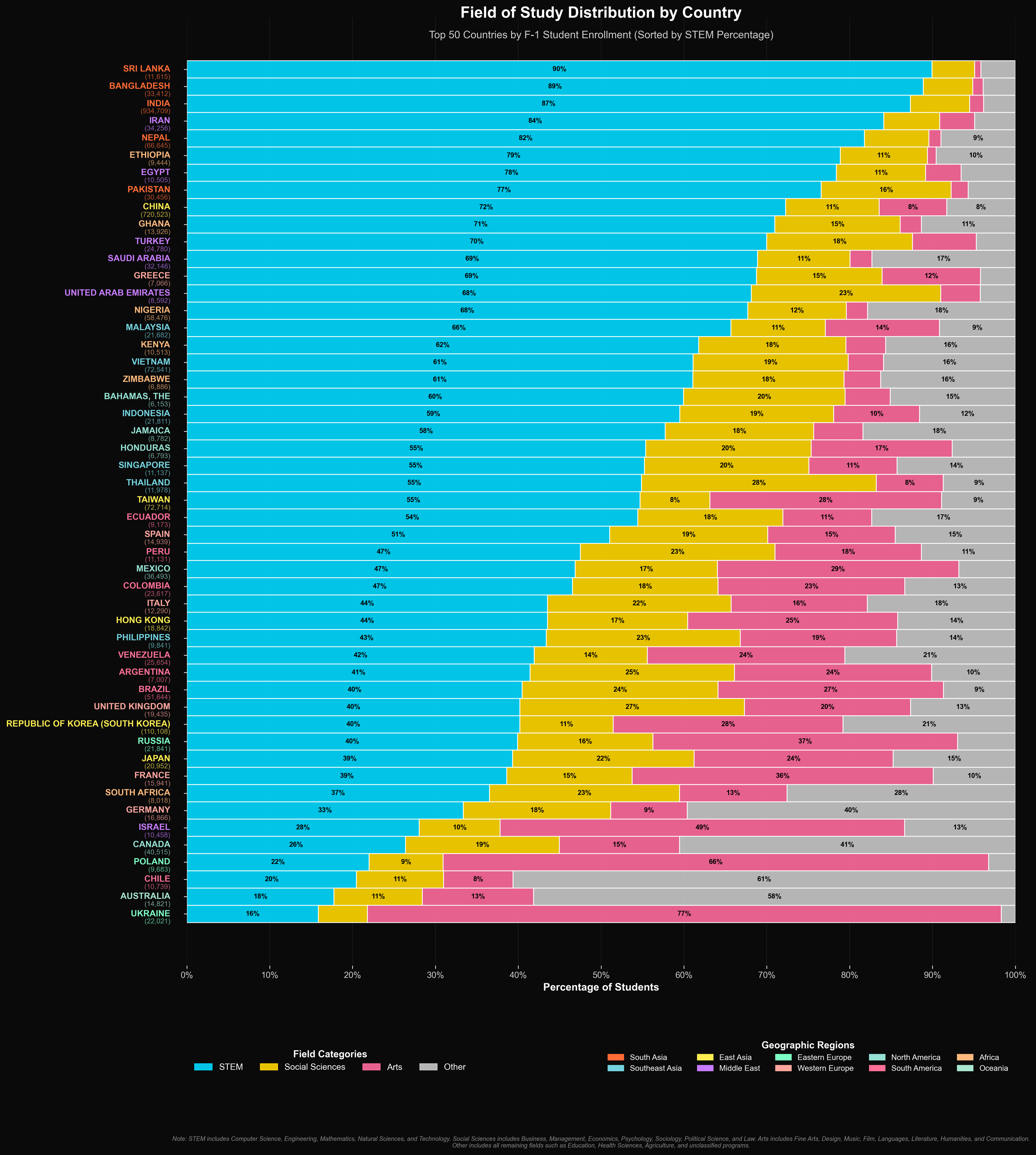
Source: Analysis by Deedy Das
Argument 2: The H1B Changes Actually Help You
Now let's talk about the elephant in the room: Trump's $100K H1B fee.
Let me show you what the USCIS clarification actually says:
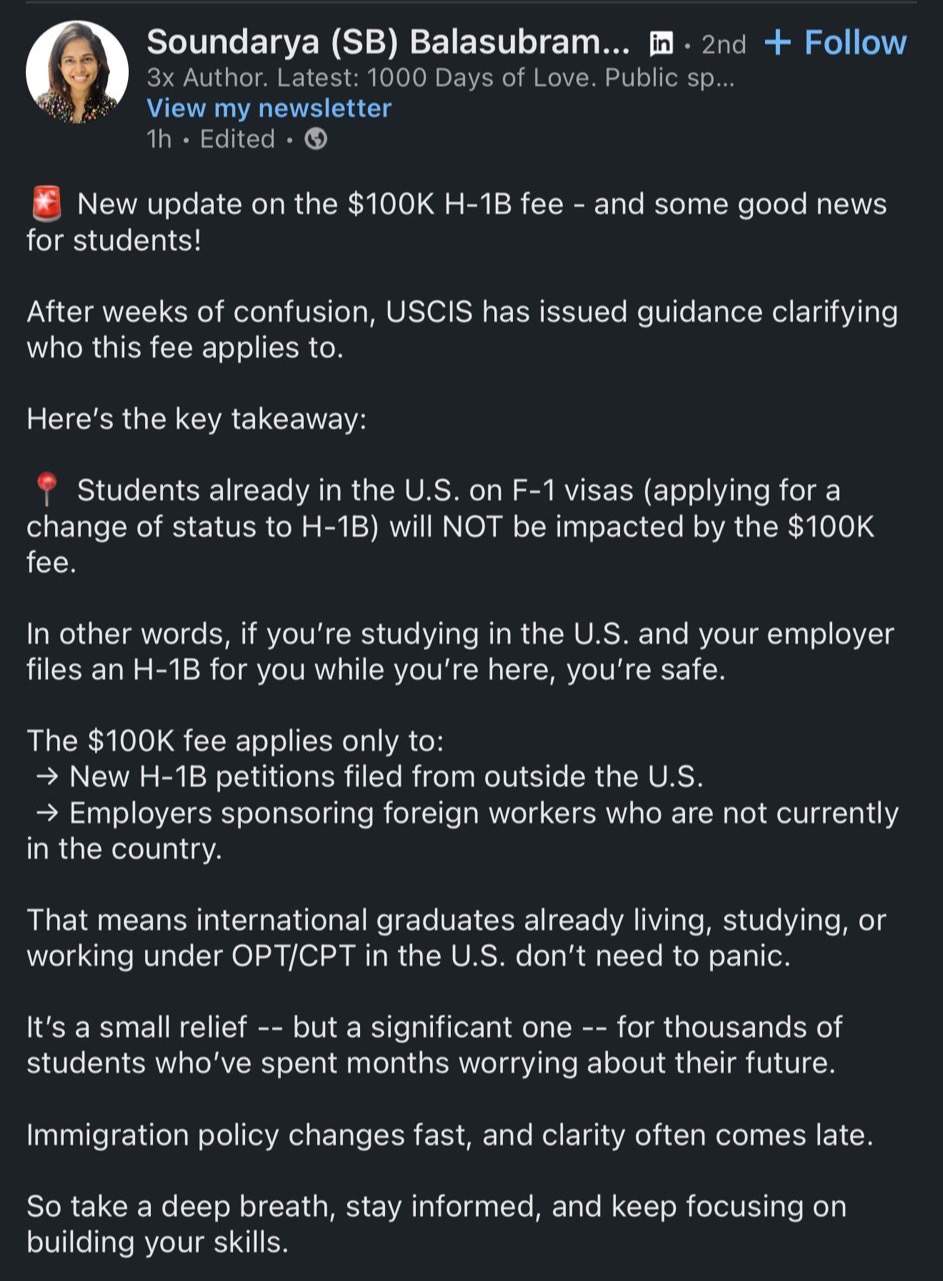
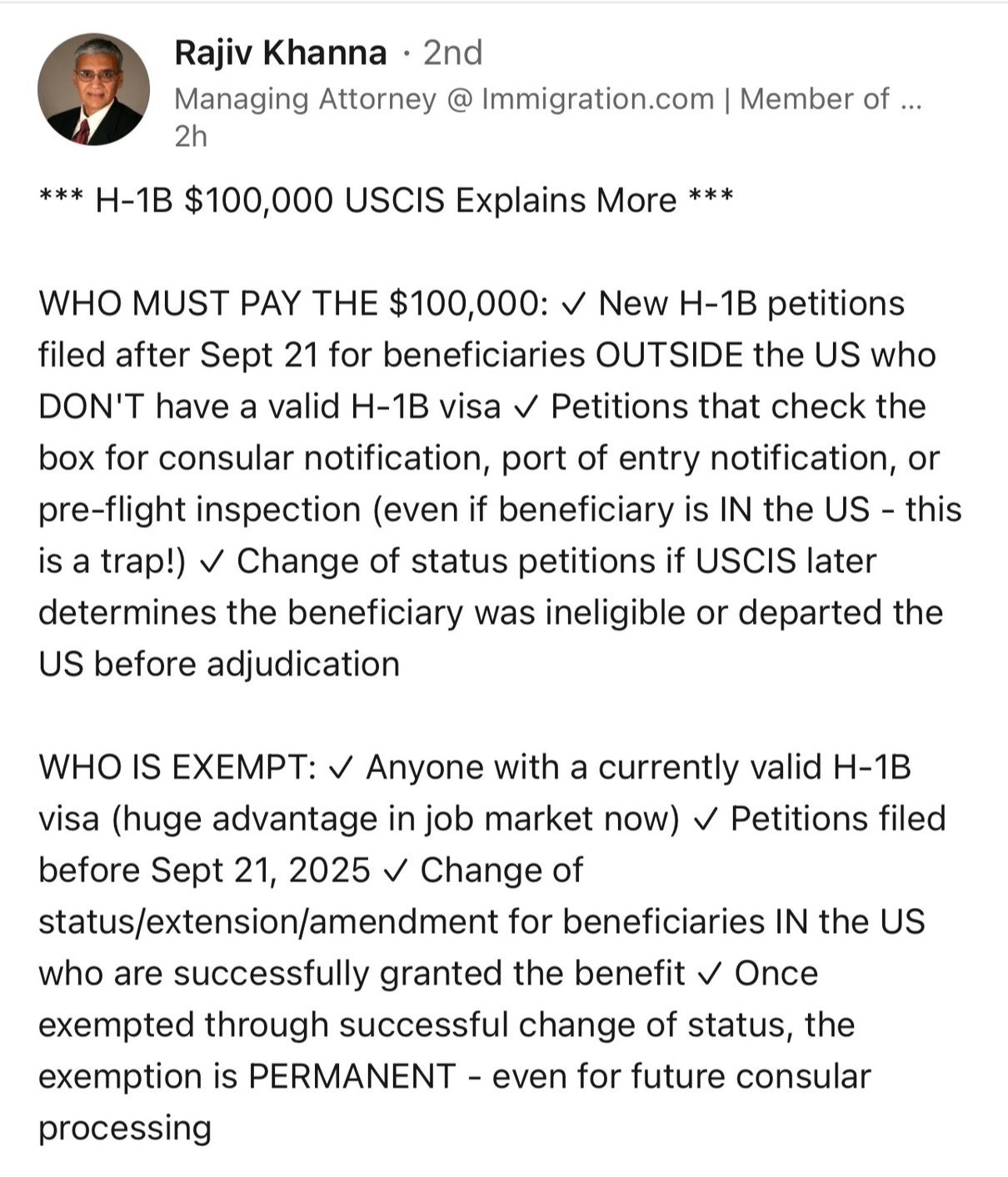
WHO MUST PAY THE $100K FEE:
- New H-1B petitions filed after Sept 21 for beneficiaries OUTSIDE the US who don't have a valid H-1B visa
- Petitions that check the box for consular notification, port of entry notification, or pre-flight inspection (even if beneficiary is IN the US - this is a trap)
- Change of status petitions if USCIS later determines the beneficiary was ineligible or departed the US before adjudication
WHO IS EXEMPT:
- Anyone with a currently valid H-1B visa (huge advantage in job market now)
- Petitions filed before Sept 21, 2025
- Change of status/extension/amendment for beneficiaries IN the US who are successfully granted the benefit
- Once exempted through successful change of status, the exemption is PERMANENT - even for future consular processing
Translation for F-1 students (Current AND Future):
This applies to ALL F-1 students—whether you're already in the US, coming in 2026, 2027, 2028, or beyond.
If you follow the normal pathway: F-1 visa → Graduate from US university → OPT → H-1B filed while physically in the United States, you are EXEMPT from the $100K fee.
It doesn't matter when you arrive. Whether you're starting your program in Fall 2026, Fall 2027, or even 2030—as long as your employer files your H-1B petition while you're physically in the US on F-1/OPT status, you are exempt.
This is a change of status petition, not a new H-1B petition from abroad. And once you're exempt through this pathway, the exemption is PERMANENT—even if you leave the US and need consular processing later.
This is GOOD news for you. Here's why:
-
It creates a competitive moat: Companies can no longer cheaply import talent from outside the US to undercut you. The $100K fee makes it prohibitively expensive.
-
It targets the real problem: The ruling is aimed at consulting body shops like TCS, Infosys, Wipro, Cognizant—companies that have gamed the H-1B lottery system for years by filing thousands of petitions to bring low-cost labor locked into 3-year contracts.
-
It gives you an advantage: If you're already in the US with skills and a degree, you're now more valuable to employers than someone overseas. Your employer doesn't have to pay $100K to hire you.
-
It proves America still wants skilled immigrants: The fact that the exemption exists for people transitioning from F-1 to H-1B shows that the US government wants to retain people who studied here. You're the intended beneficiaries of this policy.
America is not closing its doors to talent—it's closing its doors to exploitation.
Personal Opinion - founders of Gradmits
Data is powerful, but let me also share what I'm seeing right now, in 2025, living in the United States. I have done my Master's in Computer Science from Arizona University - Graduated in 2024 and I am working in the Valley. I have skin in the game.
There is a plethora of opportunity here—especially in STEM.
The places people talk about on Twitter—San Francisco, Austin, Seattle, Boston, New York, Los Angeles—these aren't just cities. They're melting pots where the greatest minds from India, China, Europe, South America, and Africa are converging, collaborating, and building the future.
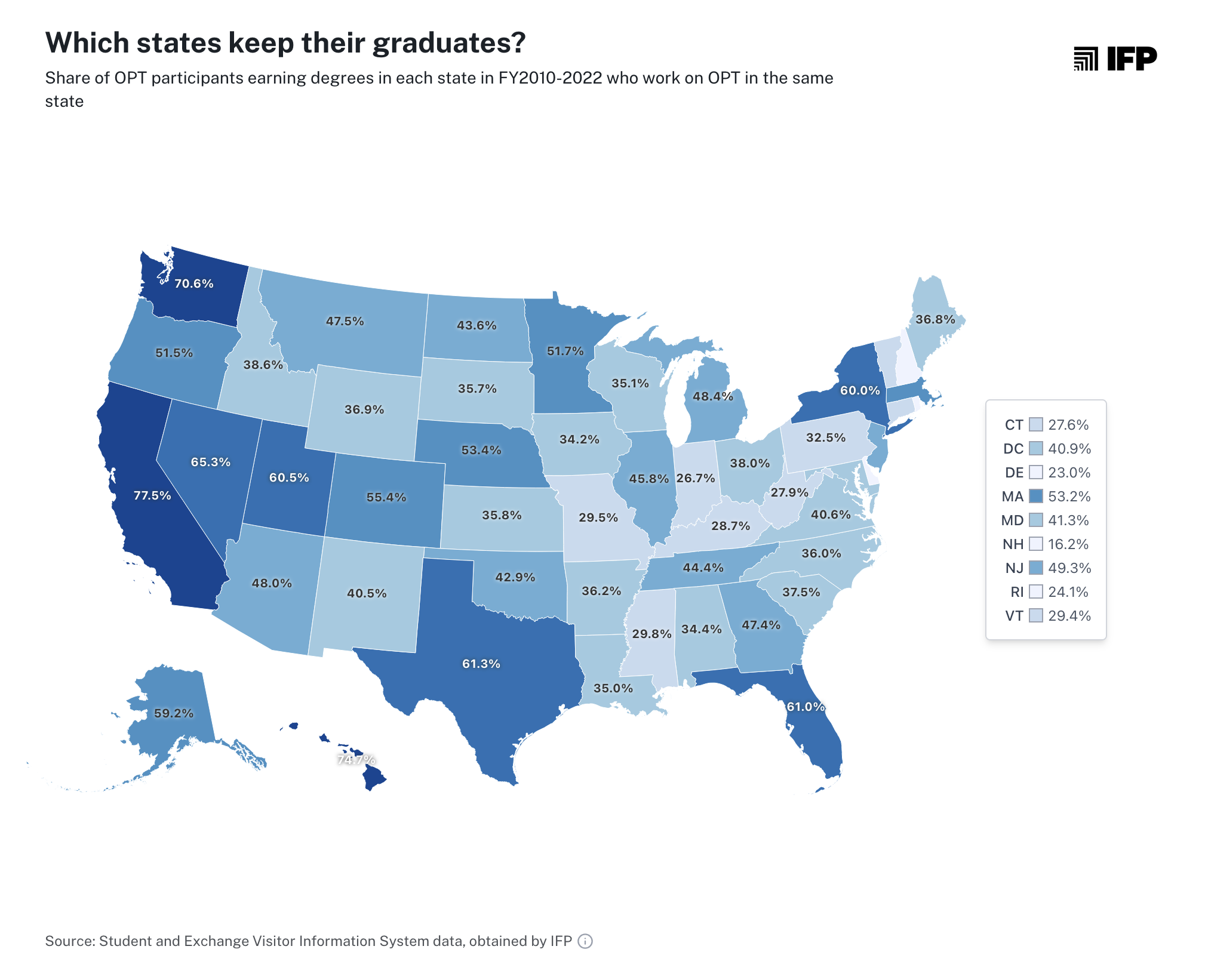
Source: Institute for Progress - OPT Observatory
This map shows what percentage of international graduates from each state who participate in OPT actually work in that same state (2010-2022 data). California leads at 77.5% retention, followed by Washington at 70.6% and Texas at 61.3%—these are exactly the tech hubs where opportunity concentrates.
Talented people who work at great companies in the US want to stay in the US long term.
Naval Ravikant on what makes Silicon Valley unique
Source: Naval Ravikant - Silicon Valley Podcast
Contrarian Thinking: This is Actually Your Moment
Right now, everyone is fearful. WhatsApp groups are filled with anxiety. Reddit threads are doomscrolling about H1B restrictions. YouTube consultants are pivoting to "Canada vs USA" comparison videos.
When everyone is fearful, that's when opportunity appears for the bold.
Let me spell out the second-order effects of this fear:
- Less competition across the board - fewer people competing for on-campus research positions, internships, TA/RA jobs, and full-time roles post-graduation
- Higher H-1B lottery odds - with the $100K fee stopping body shops from filing thousands of fraudulent petitions, the H-1B lottery pool shrinks dramatically, giving legitimate F-1 students significantly better chances of getting picked
For the students who DO come and who ARE skilled, this is a massive opportunity.
The companies still need the talent. The labs still need the researchers. The startups still need the engineers. But now there's less supply chasing the same demand.
Basic economics: your value goes up.
In the Age of AI, America Needs Smart Young Talent More Than Ever
We're entering the biggest technological shift since the internet. Artificial intelligence is going to reshape every industry, create trillions in value, and redefine how society operates.
Where is this revolution happening?
It's happening in America. OpenAI, Anthropic, Google DeepMind, Meta AI, NVIDIA, Tesla, xAI—all American companies (or American-based).
And these companies are desperate for talent. Not just any talent—world-class AI researchers, machine learning engineers, systems programmers, product builders.
Don't Take Advice from People with No Skin in the Game
This is critical: ignore armchair consultants and experts who have never even been to the USA.
You know the type:
- The uncle who read an article on WhatsApp about visa restrictions
- The YouTuber in India making "Is USA worth it in 2026?" videos for ad revenue
- The friend-of-a-friend who "heard that H1B is impossible now"
- The random Redditor who's never left their home country but has strong opinions
These people have no skin in the game. They're not risking anything. They're not living the reality.
Talk to people who are actually in the US, working in tech, navigating the system successfully. Talk to recent graduates from your target program. Talk to people on LinkedIn who made the transition from F-1 to OPT to H-1B.
The question isn't whether the opportunity exists. The question is: are you worthy of it?
Want to maximize your chances of getting into top US STEM programs? Use Gradmits's AI-powered admissions predictor to find the best-fit universities based on 250,000+ real application outcomes. No university partnerships, no hidden incentives—just data-driven recommendations to help you build your future.